Copyright metadata extraction
A pipeline that reads scanned Korean copyright contracts and consent forms and extracts the metadata needed to register the work. Our Soongsil University team built it for two public agencies: 한국문화정보원 (Korea Culture Information Service Agency) and 한국저작권위원회 (Korea Copyright Commission).
Demo and evidence
Try it
Pick a contract or a work, and the pipeline runs: each stage with its real timing, the record it returns and, for contracts, how the arbiter settled each field where the LLM and the NER model were compared. I wrote the three contracts for this page, and everything in them is made up; contract C is a scan with no text layer, so OCR has to read it first. The image and the video are public-domain works: a painting by Kim Hong-do and NASA's Apollo 11 launch film.
Click a page to open the PDF.
This replays runs recorded on 17 and 18 November 2026: each file was sent once to the pipeline's API (/api/llm-extract), and the page plays back the answer. Every run calls paid model APIs, so the page does not call the service itself. The NER model makes more mistakes on these contracts than in our tests, because I used my own layout rather than the ones it was trained on. Catching those mistakes is the arbiter's job.
Evidence
- Related paper (second author): Performance and Stability Analysis of a Fine-Tuned BERT-BiLSTM-CRF NER Model for Automated Information Extraction in Openly Licensed Works. Journal of Software Assessment and Valuation, 21(4), 53–61, 2025. doi:10.29056/jsav.2025.12.05. The pipeline uses a KLUE-RoBERTa-Large NER model from the same line of work, trained by my labmate.
- Conference paper (first author) on the arbiter: Arbitrating Two Extractors: A NER-LLM Consolidation Pipeline for Metadata Extraction from Korean Public Domain Right Documents. EEECS 2026, Osaka, July 2026.
- Conference papers (second author): Enhancing Named Entity Recognition for Korean Public Domain Legal Documents Using Vision-Language OCR and Fine-Tuned BERT-BiLSTM-CRF Model (EEECS 2025, Chiang Mai, December 2025); Performance Analysis of KLUE-BERT with B-I-O Training Data Composition for Metadata Extraction from Rights Documents as Korean Openly Licensed Works (EEECS 2026, Osaka); and two Korean conference papers (KIISE KCC 2026; 한국소프트웨어감정평가학회 2025, Outstanding Paper Award).
Consider updating the public repo, which still shows the first version.
The problem
- Context: 공유마당 (Korea Copyright Commission) and 공공누리 (Korea Culture Information Service Agency) list works that anyone may reuse: expired, donated, Creative Commons and Korea Open Government License works.
- Manual work: every new work is checked and described by hand before it is listed.
- Fields needed: the work's title and type, who grants the rights and who receives them, their addresses and contacts, the rights covered and the signing date.
- Where they sit: scanned contracts and consent forms in several types and layouts, and the image and video files themselves.
- The risk: typing is slow and one wrong field means a wrong registration, so the system must show how sure it is, field by field.
- Our part: Soongsil's team extracts each work's metadata, from text and from images.
The system
What I did
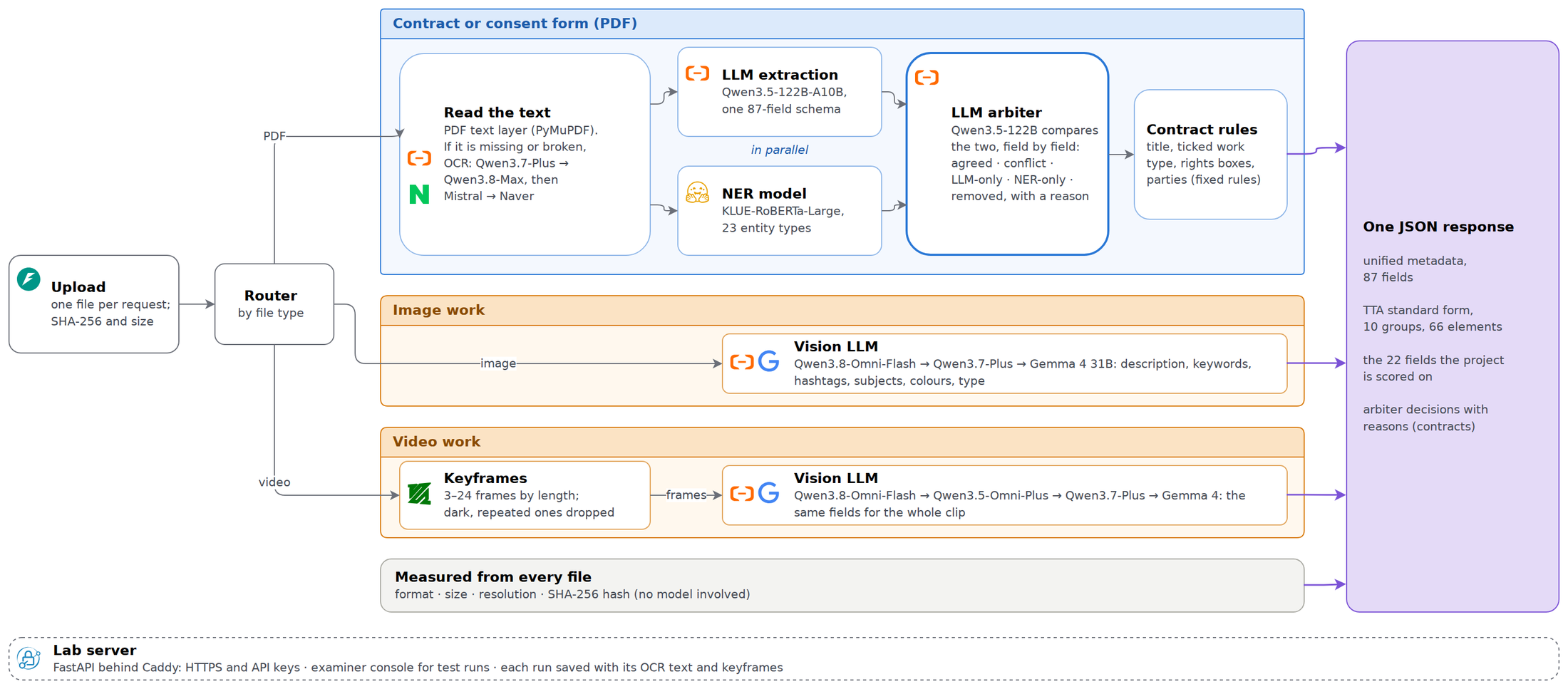
- One API for documents, images and video. A router sends each upload down its branch. Contracts and consent forms: the PDF text layer, or OCR when there is none; then LLM extraction with Qwen3.5 and a KLUE-RoBERTa-Large NER model (built by a labmate) in parallel; an LLM arbiter; and deterministic rules for the title, the ticked work type, the rights boxes and the parties. Images and video: a vision LLM describes the work, with keyframes chosen from videos, and format, size, resolution and hash are measured from the file. It is served as a web app and a REST API, which a partner company's platform calls during the project. It now runs on our lab's server behind HTTPS, with API keys. My part was the LLM stages, the OCR and vision stage, and connecting them into one pipeline.
- Two extractors and an arbiter. The LLM and the NER model fail in different ways, so the pipeline runs both. The arbiter labels each field as agreed, conflict, LLM-only or NER-only, with a short justification in Korean, so a reviewer knows which fields to check first.
- One schema instead of five. I merged five document-specific schemas into one unified schema (87 fields today), which replaced five extraction prompts with one shared prompt. Each response also carries the TTA standard form (10 groups, 66 elements) and the 22 fields the project is scored on.
- Fallback chains. OCR falls back from Alibaba's Qwen to Mistral to Naver, and vision from Qwen Omni to Qwen Plus to Gemma 4, with retries; a content-filter refusal also moves to the next model. Extraction keeps running through outages, rate limits, model retirements and failed responses.
- Earlier version. The first version (2025, public repo) used embedding-based field matching with BGE-M3, detected the document type, and learned from users' corrections.
Results
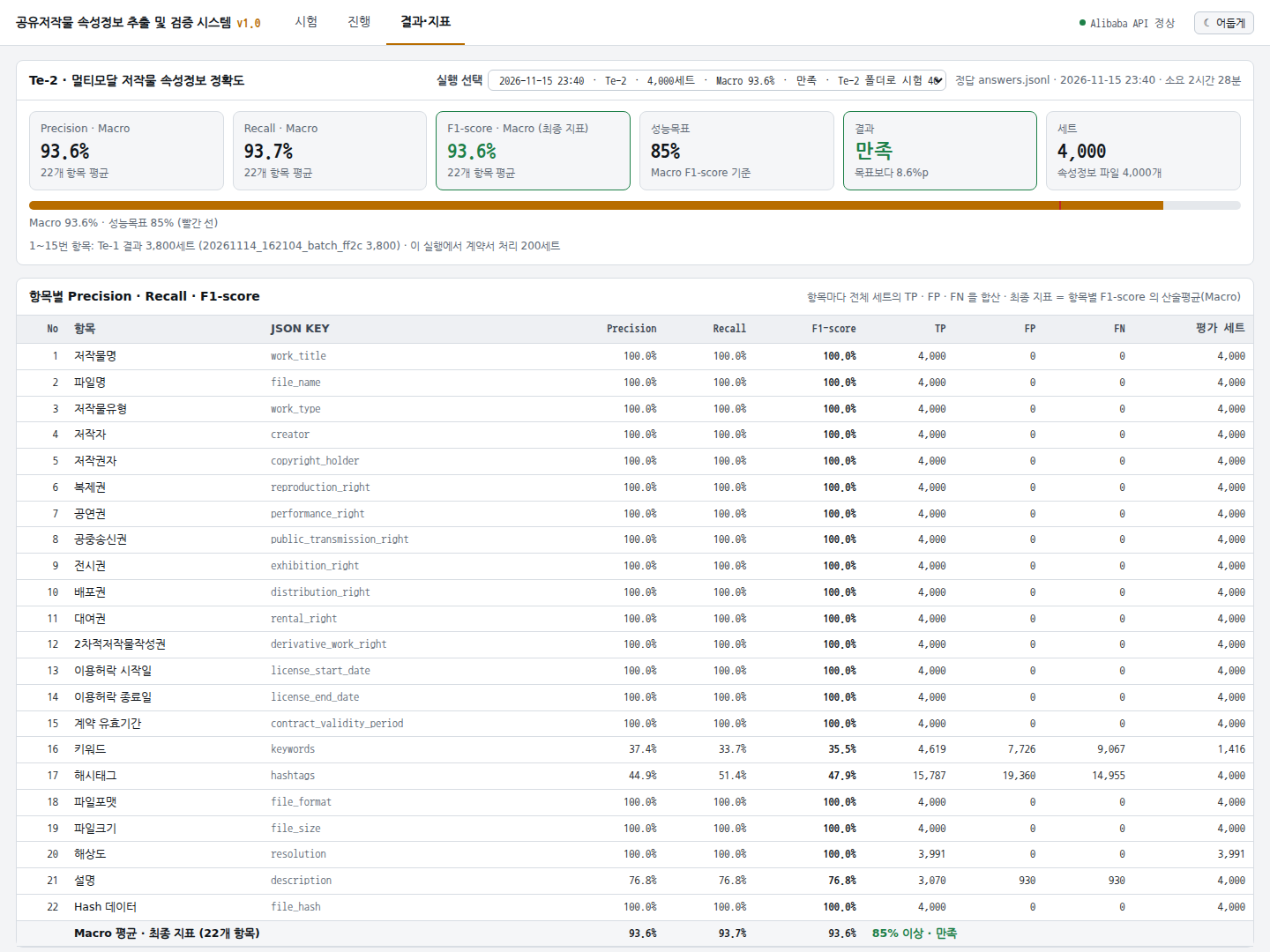
The project measures this part by metadata accuracy: at least 80% in the first year and 85% in the second, on 1,000 test items for each type of work (expired, donated, Creative Commons, Korea Open Government License). An accredited test lab checks the second-year result. Before that test, we rehearse it on 4,000 sets against our own answer key.
These are internal rehearsals on test contracts we generated, which all have a text layer, so OCR was not exercised. In Te-2 the 15 contract fields come from the matching Te-1 contract. The official test by the accredited lab is still to come.