Korean assistant LLM: fine-tuning a 27B open-weight model
I lead the fine-tuning of Qwen3.8-27B, an open-weight LLM, for a Korean-first AI assistant that calls tools. The goal is a self-hosted model that answers the assistant's users as well as the commercial API models production mostly uses, without breaking tool calling. The work covers the data pipeline from real production traffic, a LoRA trainer for 64k-token prompts and the evaluation that decides which run goes forward.
Demo and evidence
There is no public demo: the model was trained on private production conversations, and nothing on this page shows their content. The numbers below are counts and scores only.
The problem
- The assistant: a Korean-first AI assistant that answers users and calls tools. Production mostly uses commercial API models; the aim is a self-hosted open-weight model that can match them.
- The gap: on held-out real conversations, a blind judge scored the base model 5.46 out of 10 and production's own answers 6.92.
- Long prompts: each training sample carries the whole conversation and its tool results, with a median of 26.5k to 32.6k tokens and up to 65k.
- Tool calling must hold: the model has to keep making correct and parallel tool calls while it learns the assistant's answers.
- Privacy: the data is real traffic, so it has to be scrubbed of personal data and split so that no conversation reaches the test sets.
The system
What I did
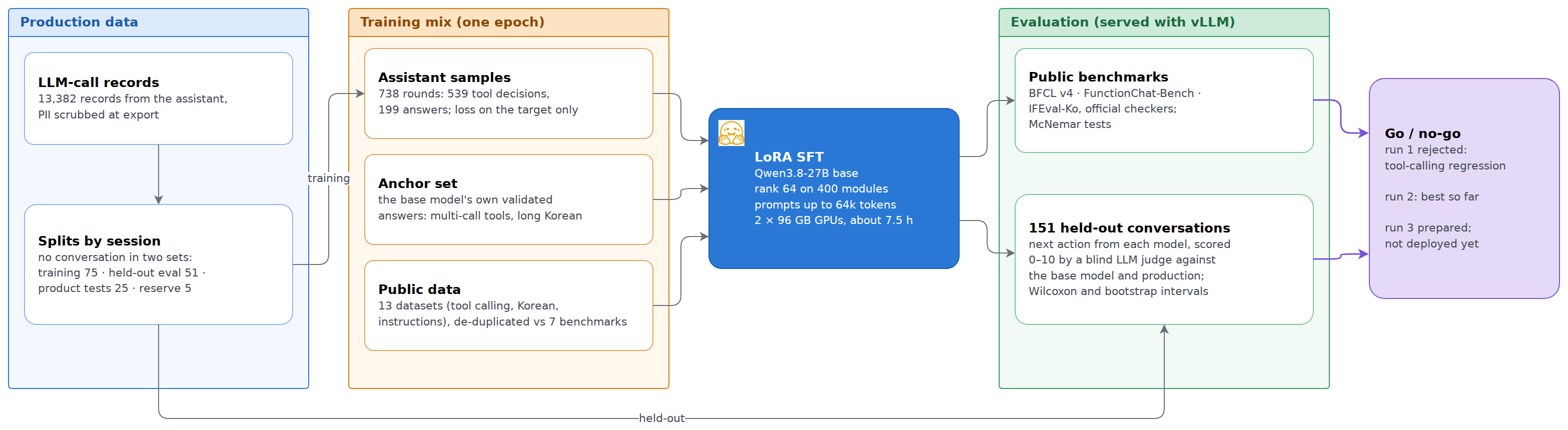
- Data. 13,382 LLM-call records of the assistant, scrubbed of personal data at export, turned into one training sample per tool decision or answer, with loss only on that target (checked: no labels on 7,317 history messages). Sessions are split so that no conversation is in two sets: 75 for training (58 in runs 1 and 2), 51 for evaluation and 25 kept for the product's own tests. For final answers, an LLM judge picked the best of three candidates: production's answer, a commercial API model and the base model's own samples.
- Training mix. The assistant samples, an anchor set of the base model's own validated answers (multi-call tool answers, long Korean answers) to keep its good habits, and 13 public datasets for tool calling, Korean and instruction following, de-duplicated against 7 benchmark test sets with 13-gram and MinHash checks.
- Trainer. LoRA SFT on Qwen3.8-27B: rank 64, alpha 128, 400 modules, 435M trainable parameters. Prompts up to 64k tokens in 11 length buckets, gradient checkpointing and the chat template production serves. The model is split across two 96 GB GPUs (77 GiB peak on each), and one epoch takes about 7.5 hours.
- Run 1 and the fix. Run 1 broke parallel tool calling: it always made a single call, and BFCL v4 parallel calls fell to 0%. The cause was the mix, about 90% single-call examples, and the learning rate. Run 2 raised multi-call examples to 38%, added the anchor set and halved the learning rate, and it beat the base model on tool calling.
- Evaluation. Every model is served the same way with vLLM, the production chat template and thinking off. Public benchmarks use their official checkers, with McNemar tests. On 151 held-out turns, a blind LLM judge (Claude Opus 5.5) scores all candidates 0 to 10 side by side, anonymised and shuffled, with production's answer as the bar to beat; Wilcoxon tests and bootstrap intervals give the uncertainty.
- Thinking test. With low-effort thinking, run 2's final answers are level with production's (6.06 against 6.12, p = 0.92), at 7 to 10 seconds more per answer. Serving stays thinking-off for now, by the product owner's decision.
Results
6.10blind-judge score on 151 held-out conversationsBase model 5.46 (p = 0.002); production's own answers 6.92
92.0%BFCL v4 parallel tool callsBase 82.5%; the rejected first run 0%
49 → 24turns breaking a system-prompt ruleOut of 151, base model against run 2
6.06final-answer score with low-effort thinkingLevel with production's 6.12 (p = 0.92), on 71 items
| 151 held-out real conversations | Base | Run 1 | Run 2 | Production's answers |
|---|---|---|---|---|
| Judge score, 0 to 10 (higher is better) | 5.46 | 5.66 | 6.10 | 6.92 |
| Turns with a system-prompt rule violation | 49 | 35 | 24 | — |
| Turns with invented facts | 16 | 12 | 10 | — |
| Public benchmark (n) | Base | Run 1 | Run 2 | Run 2 vs base |
|---|---|---|---|---|
| BFCL v4, all categories (1,390) | 85.9% | 58.0% | 87.5% | +1.6, p = 0.015 |
| BFCL v4, parallel calls (200) | 82.5% | 0.0% | 92.0% | +9.5, p < 0.001 |
| BFCL v4, irrelevance (240) | 72.5% | 91.2% | 73.8% | +1.3, not significant |
| FunctionChat-Bench, function selection (500) | 93.4% | 98.8% | 96.0% | +2.6, p = 0.029 |
| FunctionChat-Bench, exact match (500) | 89.4% | 93.0% | 90.6% | +1.2, not significant |
| IFEval-Ko, prompt strict (342) | 79.2% | 73.1% | 76.0% | −3.2, not significant |
| IFEval-Ko answers that loop to the token limit (342) | 0 | 32 | 3 |
- Against the base model: run 2 scores 0.64 points higher on the held-out conversations (95% interval +0.23 to +1.03, p = 0.0024), with half the rule violations.
- Against production: run 2 is still 0.82 points below production's own answers with thinking off. With low-effort thinking its final answers are level (71 items: 6.06 against 6.12).
- Still to watch: instruction following on IFEval-Ko is slightly lower than the base model (not significant), and 3 answers loop to the token limit.
- Next: a third run on 738 samples from 75 sessions is prepared and waits for time on the shared GPU server; stronger teacher answers, preference training (DPO) and compression to the 4-bit production format follow.